The routine takes two hours. The supplements cost more than food. The goal is a score on a scale that does not officially exist.
Literal meaning: Looksmaxxing describes the practice of systematically maximising physical attractiveness through any available means — skincare, fitness, surgery, dental work, posture correction, and increasingly procedures targeting bone structure such as jaw contouring and canthal tilt correction. At the extreme end: bone smashing — deliberately striking the jaw or cheekbones with a hammer, based on the misapplied premise that damaged bone rebuilds itself into a more “optimal” structure. The female equivalent is quieter but no less physical: high heels that permanently alter foot structure and gait; mewing — pressing the tongue against the palate for hours to allegedly reshape the jaw over time; extreme caloric restriction that disrupts hormonal systems. The bodily logic is the same: endure structural discomfort now, receive structural improvement later. The “-maxxing” suffix signals optimisation to a maximum: not improvement but maximisation. The practice applies to both men and women. Men are scored on a fixed hierarchy: Subhuman, Low Tier Normie, Mid Tier Normie, Chad, Adamlite, True Adam (10/10). Women are rated on a parallel scale — Becky, Stacy, Gigastacy — and are told to optimise their SMV through weight, skin, femininity, and style. The underlying logic is identical: attractiveness is a number, and that number can be raised. Below a four, regardless of gender: Subhuman. The vocabulary is the ideology.
Origin: The term emerged from incel and Manosphere forums in the early 2010s, where physical appearance was theorised as the primary determinant of sexual and social success. It spread into mainstream TikTok and YouTube culture from around 2022, generating a large content ecosystem from skincare routines to surgical bone contouring. Dutch research cited by De Volkskrant found that approximately half of Dutch 15-year-olds regularly encounter manosphere content — of which looksmaxxing is a direct product. Renaissance artist Albrecht Dürer mapped ideal human proportions in 1528 — but understood them as unreachable for mortals. Looksmaxxers have inverted that logic: the ideal is not only reachable, it is compulsory. By 2026, looksmaxxing had left the forums entirely. Braden Peters — known as Clavicular, after the 19.5-inch clavicles he reported to the New York Times — livestreamed his life six to ten hours a day on Kick, earned more than $100,000 a month, and had millions of followers across TikTok and Instagram. He had spent $35,000 on jaw surgery. The Times, Le Monde, and The Guardian profiled him as the face of toxic hypermasculinity. His followers saw something else: proof that you can go from “subhuman” to “Chad.” The vocabulary — ascend, jester, subhuman — is now widely known among Gen Z.
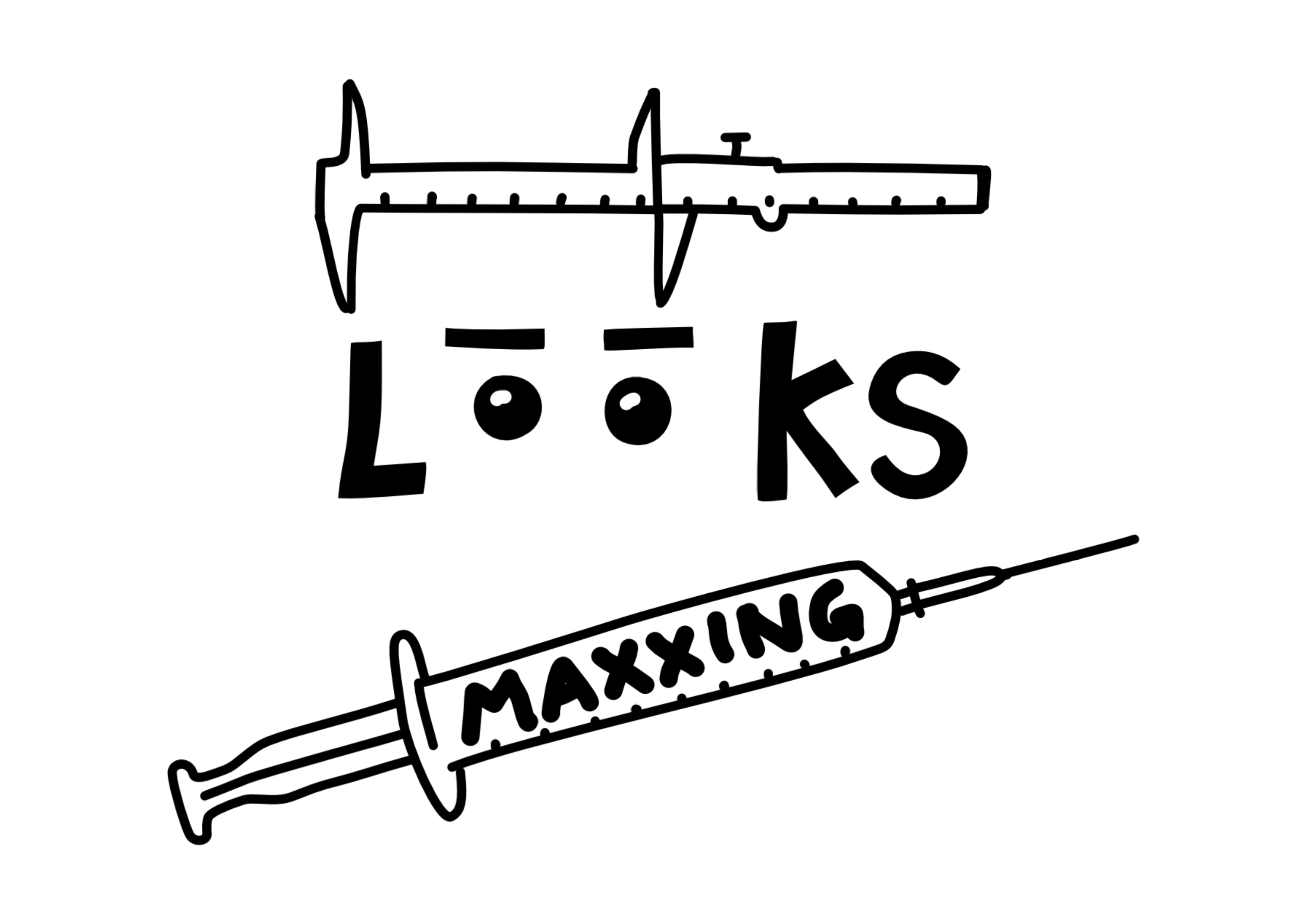 By Narrative Typographer Anne-Marie Bruinsma
The systematic optimisation of physical appearance as a measurable, scored project — where the body becomes a product to be maximised toward an externally defined, pseudoscientific standard.
The Appeal: Looksmaxxing offers agency in a domain where many people feel powerless. If attractiveness determines outcomes — socially, romantically, professionally — then optimising it is rational. For many participants it produces genuine confidence and practical self-care skills. Journalist Bregje Hofstede (De Correspondent, 2026) frames it precisely: looksmaxxing is not stupidity. It is a logical response to a culture that rewards only the measurable and visible — what she calls “metafysische precariteit”: existential insecurity without intrinsic value to fall back on.
The Friction: The logic has no endpoint. SMV (Sexual Market Value) — attractiveness quantified as market position — is the framework: your score can always be higher. The hierarchy is explicit and merciless: looksmaxxers are unsparing about age, and “descension” is inevitable. Forum posts ask: “At what age is it over?” Answers range from 30 to 50. Blackpill is the terminus for those who conclude the project is futile — bone structure is destiny. Body Dysmorphic Disorder sits at the clinical end: increasing BDD presentations in men are now associated specifically with looksmaxxing content. Comparison Culture is the environment: the content produces constant upward comparison against algorithmically optimised faces. British philosopher Iris Murdoch argued in The Sovereignty of Good (1970) that reducing human value to the visible and measurable is a category error — morality and intrinsic worth cannot be quantified. Looksmaxxing is what happens when that argument loses. Clavicular built his following partly by rating and publicly humiliating women based on their appearance — applying the same SMV vocabulary to them that looksmaxxers apply to themselves. The promise of looksmaxxing is that ascension leads to women. What NRC critic Tristan Theirlynck observed on a six-hour livestream from Mykonos was different: girls rejecting him, champagne drunk alone, a girlfriend he snapped at. The endpoint of ascension, as seen from the outside, was not connection. It was isolation. That gap between the promised outcome and the lived reality is also the engine of the content model: Peters deliberately posted his Paris failures because ridicule generates the same algorithmic signal as admiration — both are engagement. Heijne (2026) identifies this as Ragebaiting: the provocation is the product, not the looksmaxxing content. The political dimension is not incidental: whoever can promise the fundamentally insecure young man that he is “worth something” — regardless of his canthal tilt — holds enormous power. Marketers and populist politicians both know this.
Why This Matters: Looksmaxxing makes the body into a project with a never-ending to-do list. The word “Subhuman” — applied to anyone scoring below four — carries a history. Once you teach people to rank themselves and others on a hierarchy from valuable to worthless, that logic becomes available for application to entire groups. When extreme plastic surgery becomes a tribal marker — as in the so-called “Mar-a-Lago face”, the uniform aesthetic of heavily filled, surgically tightened faces associated with wealthy political circles — looksmaxxing becomes a geopolitical instrument. The optimised body signals class, allegiance, and access. What began as an individual optimisation project becomes a legible political identity worn on the face. And what began as an incel-forum term is now a product category: a €113 skincare kit, a paid analysis platform, 75,000 community members. The gua sha tool promising “sharper features in minutes” is sold by the same logic as the forum that coined the word Subhuman. The packaging changed. The ideology did not.
Related terms: SMV (Sexual Market Value) · Blackpill · Manosphere · Subhuman · Chad · Body Dysmorphic Disorder · Comparison Culture · Sigma Male · Tradwife · Incel · Ragebaiting
Read more:
Primary:
- Ging, D. (2019) — Alphas, Betas, and Incels. Men and Masculinities
- Konig et al. (2025) — Looksmaxxing: Straddling the Inflection Between Self-Enhancement and Self-Harm. SAGE Open Medicine
Secondary:
- Hofstede (2026) · Usborne (2024) · Murdoch (1970) — journalism + philosophy