She bakes bread, raises children, defers to her husband — and films all of it for an audience of millions.
Literal meaning: Tradwife — from traditional wife — describes women who publicly embrace and promote a domestic, homemaking role as their primary identity: cooking, cleaning, child-rearing, and deference to a male provider, presented as a deliberate, values-driven lifestyle choice rather than economic necessity. Most tradwives are also influencers: content creators who document and monetise this domestic life through YouTube, TikTok, and Instagram — reaching audiences of hundreds of thousands to millions. The aesthetic is curated, the lighting is soft, and the platform is a business.
Origin: The term entered online discourse around 2018–2019, associated with accounts on Instagram, YouTube, and later TikTok that presented aestheticised domesticity as a counter-cultural statement against feminist career culture. Its first public face was British: the homemaker and author Alena Kate Pettitt, who had blogged about staying at home since the late 2000s and became the word’s example in January 2020, when a BBC film showed her ironing her husband’s shirts; she never used the term herself, and Elmhirst (2024) follows it out of her hands, in her own summary, from aesthetic to politicised to “its own monster”. Researchers including Annie Kelly (2018) have documented how tradwife content draws simultaneously on nostalgic aesthetics, Christian traditionalism, and white nationalist ideology — with varying degrees of explicitness across different accounts. The same SMV logic that structures Manosphere content for men operates here: the tradwife optimises her femininity, domesticity, and deference to maximise her value as a mate — the female route through the same market logic that drives Looksmaxxing and defines Sigma Male — different performances, the same underlying framework. Ging (2019) documents how this ideological ecosystem produces mutually reinforcing content categories across gender lines.
The term reached general use through a single article. In July 2024 the Sunday Times Magazine published Megan Agnew’s profile of Hannah Neeleman, known online as Ballerina Farm, under a standfirst that set the terms of every argument since: is this an empowering new model of womanhood, or a hammer blow for feminism. Neeleman had not called herself a tradwife; earlier coverage had framed her as a resilient woman competing in a beauty pageant shortly after giving birth. The label was applied from outside, and she answered it in two Instagram posts. Searches for “tradwife” spiked the day after publication, which makes the profile the point at which the word stopped belonging to the subculture that coined it.
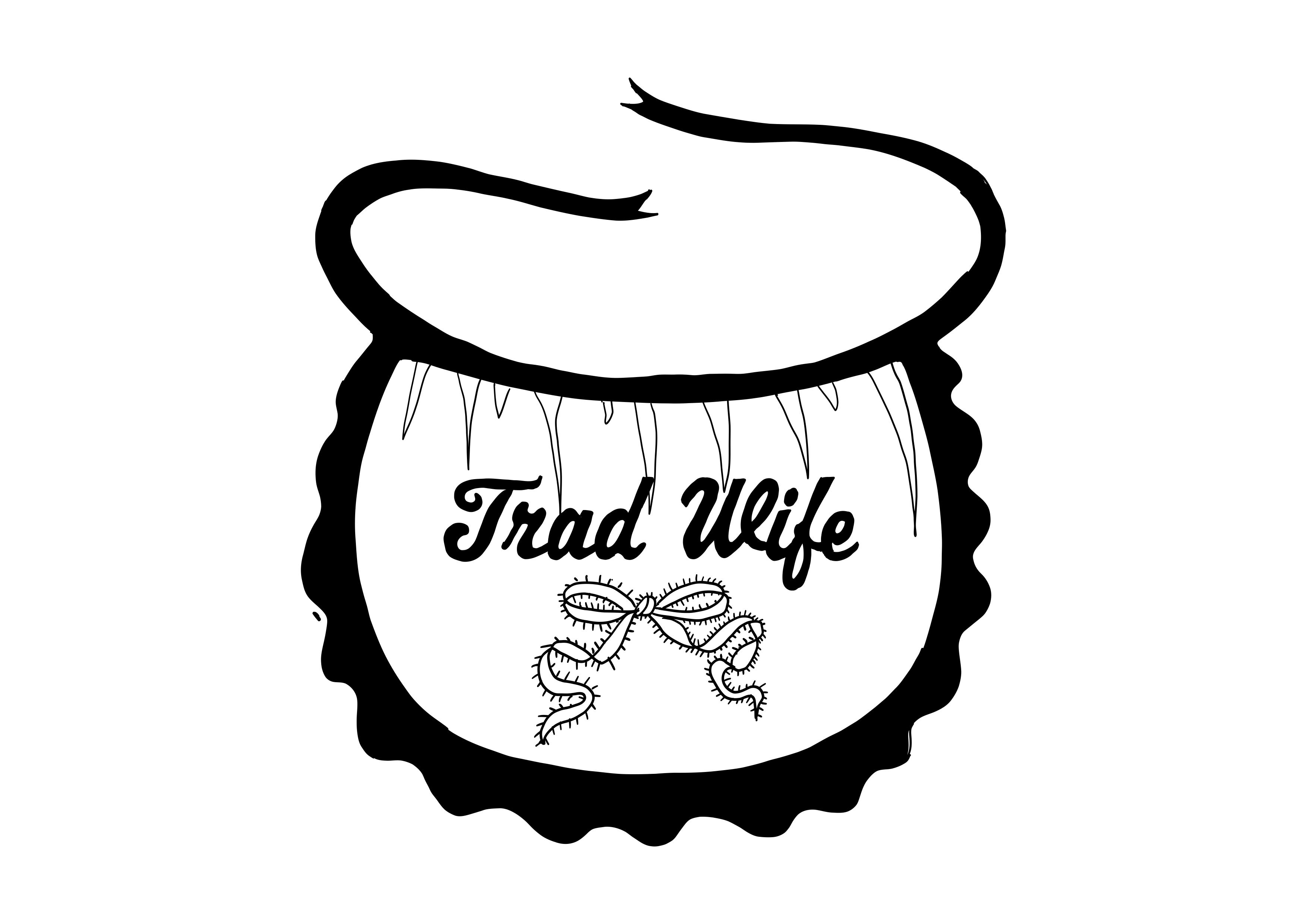 By Narrative Typographer Marieke de Vogel
Domestic femininity performed as aspirational content — where the rejection of professional identity is distributed as a lifestyle brand.
The Appeal: Tradwife content offers a coherent alternative to the “have it all” narrative that many women experience as exhausting and unachievable. The aesthetic is beautiful, the domestic scenes are calm, and the message — that homemaking is valuable and dignified — addresses a genuine cultural dismissal of domestic labour. For women who prefer or need a domestic role, the framework provides identity and community. Betz, Liss & Ramsey (2026) identify three conditions that made tradwife content flourish: frustration with feminism’s incomplete revolution on domestic labour, COVID-19 nostalgia for domestic life, and alignment with far-right political communications that validate gender essentialism.
The Friction: The paradox is structural. Highlight Reel — showing only the best — is the format: the tradwife’s content is carefully produced, lit, and edited. The brand is funded by the platform economy the tradwife appears to reject. Provider — the male caretaker role as transaction — is the complementary framework: tradwife and provider are a paired set within SMV logic. Researcher Annie Kelly (2018) has documented the ideological spectrum: the same aesthetic runs from benign domestic preference to explicitly white nationalist “white baby fever” content — the Wellness-to-Alt-Right Pipeline traced from the softer end of that spectrum. Betz et al. (2026) note that this “return to tradition” is only accessible to economically privileged women — and carries white supremacist ideology and anti-transgender sentiment through the same nostalgic imagery. Purity Culture provides the ideological architecture: the clean body, the pure household, the uncorrupted femininity — the same contamination logic that runs from religious purity to nationalist demographics runs through the aesthetic of the tradwife kitchen. The platform recommendation system does not distinguish between them, and the migration between them is documented. Sykes & Hopner (2024) give that spectrum an empirical basis and change what it means. Observing thirty-six tradwife profiles over ten months, they found the same accounts calibrating their content to how strictly each platform moderates: homemaking and #tradlife on Facebook and Instagram, explicit ideological argument and attempted redpilling on Twitter/X, YouTube, Rumble and Gab. The soft version and the hard version are not different populations. They are one influencer adjusting to her audience and her moderators, which is what turns the Wellness-to-Alt-Right Pipeline from an observation about adjacency into a distribution strategy. The reception splits along the same lines. Founti (2025) found that on Neeleman’s own Instagram, where the audience selects itself, approving readings dominate, while readers of the Sunday Times profile largely read the same performance as oppositional. Kady Ruth Ashcraft (2024) in Jezebel drew the sharpest version of that oppositional reading and then refused to let it settle: to paint Neeleman purely as a victim, she wrote, absolves her of her active participation in perpetuating the fantasy. Constraint and complicity hold at once, which is why the argument about tradwives does not resolve. Body Dysmorphic Disorder is not tradwife’s own terminus — that consequence path stays softer, aspirational rather than clinical — but it names where the same SMV logic ends up on Looksmaxxing’s side of the market.
Why This Matters: Tradwife makes visible the contradiction between form and content — a rejection of modern values distributed through the most modern available infrastructure. The influencer who monetises submission is also the entrepreneur who built a brand. Once you see the platform economy behind the aesthetic, the “return to tradition” is legible as a content category.
Related terms: Provider · SMV (Sexual Market Value) · Womanosphere · Manosphere · Highlight Reel · Stay-at-home Girlfriend (SAHG) · Purity Culture · Looksmaxxing · Wellness-to-Alt-Right Pipeline · Sigma Male · Body Dysmorphic Disorder
Read more:
Primary:
- Betz, Liss & Ramsey (2026) — Not the Solution We Proposed. Psychology of Women Quarterly
- Sykes, S. & Hopner, V. (2024) — Tradwives: Right-Wing Social Media Influencers. Journal of Contemporary Ethnography
Secondary:
- Kelly (2018) · Agnew (2024) · Ashcraft (2024) · Bower (2024) · Ging (2019) · Founti (2025) · UvA (2024) · Parents (2024) · Vogue (2024) · Elmhirst (2024) · Wikipedia · Ballerina Farm (Instagram) · The Darling Academy — journalism, a master’s thesis, the manosphere frame, public commentary, and the accounts themselves